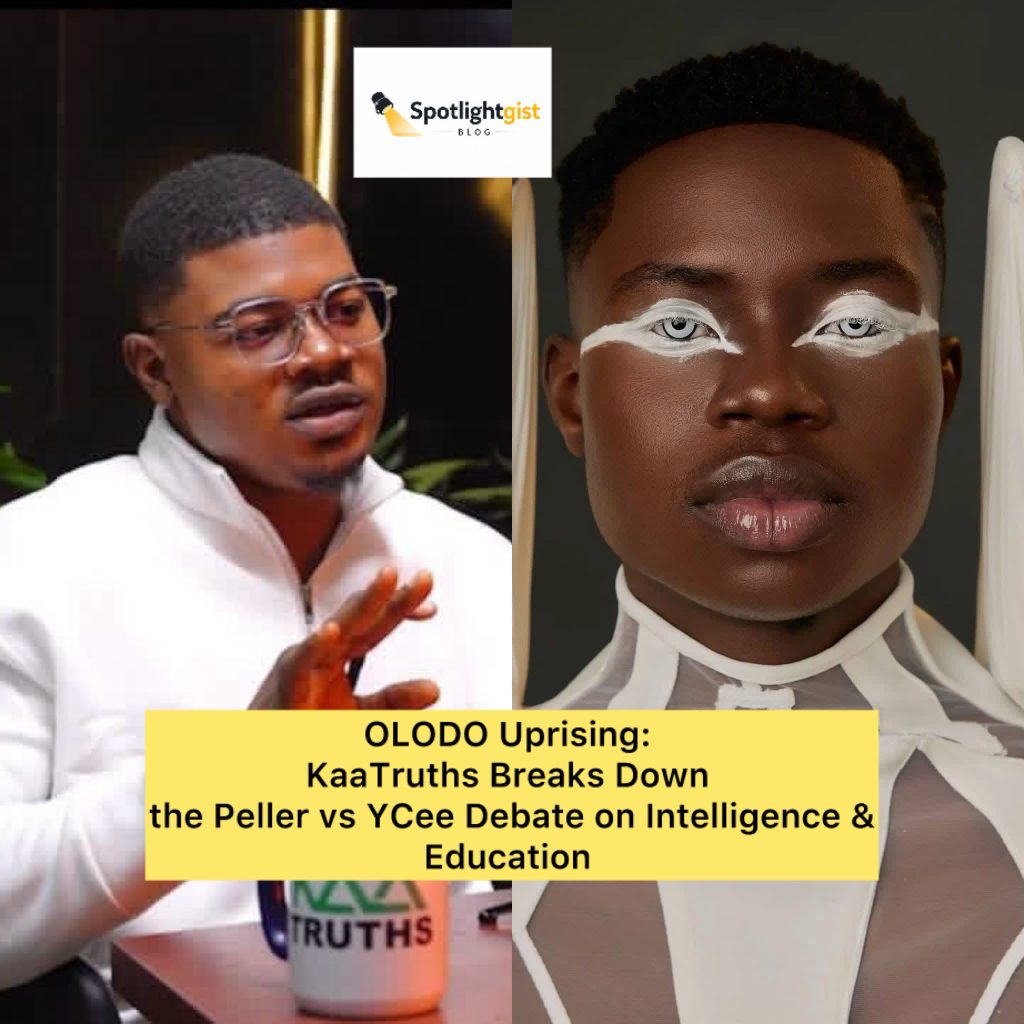
OLODO Uprising in Nigeria: KaaTruths Says Intelligence Wears More Than One Face
The phrase “OLODO Uprising” has become one of the hottest topics across Nigerian social media, sparking intense debates about education, intelligence, success, and the changing values of today’s generation. What began as an online exchange involving popular TikTok personality Peller and Nigerian rapper YCee has now grown into a nationwide conversation, attracting opinions from entertainers, professionals, students, and public commentators.
Among those who have shared thoughtful opinions is podcast host KaaTruths, whose balanced analysis has resonated with many Nigerians. Rather than choosing sides, KaaTruths examined the issue from a broader perspective, arguing that intelligence cannot be measured solely by academic qualifications.
His comments have encouraged many people to rethink what it truly means to be intelligent in a world where digital creators, entrepreneurs, engineers, doctors, teachers, and artists all contribute to society in different ways.
Understanding the Origin of the Debate
The controversy began when rapper YCee expressed concerns about the growing admiration for internet personalities whose popularity appears to overshadow professionals with years of education and experience.
His comments generated mixed reactions.
Some Nigerians agreed with him, arguing that the country is gradually celebrating entertainment more than education.
Others strongly defended creators like Peller, insisting that success should not be judged by academic certificates alone.
As expected, social media quickly became divided.
Some users described Peller as an example of determination and creativity, while others questioned whether viral fame should carry so much influence.
It was within this heated atmosphere that KaaTruths stepped into the conversation.
Instead of attacking either individual, he encouraged Nigerians to examine the bigger picture.
“Peller Does Not Have Formal Education”
KaaTruths began by acknowledging a fact that almost everyone already knows.
According to him, Peller does not possess formal education.
He did not attempt to deny or minimize that reality.
Instead, he immediately pointed out something many people often forget.
Formal education and intelligence are not the same thing.
Although education provides knowledge, discipline, and qualifications, intelligence is much broader.
History is filled with people who changed industries, built companies, created inventions, and influenced millions despite having little or no formal education.
Likewise, there are many highly educated individuals who never translate their academic achievements into practical success.
For KaaTruths, the discussion should never be reduced to whether someone attended school.
The more important question is this:
What has that person managed to build with the opportunities available to them?
Building a Digital Empire Requires Intelligence
Many critics focus on Peller’s grammar, manner of speaking, and lack of formal education.
However, KaaTruths believes these criticisms overlook something much more important.
Building a successful online brand is not easy.
Millions of people create videos every day.
Only a tiny percentage become household names.
Standing out in such a competitive environment requires originality, consistency, confidence, resilience, and a deep understanding of what audiences enjoy watching.
Peller did not become famous by accident.
He understood how to capture attention in the first few seconds of a video.
He learned how to create conversations that spread across multiple social media platforms.
He built an identity that people could instantly recognize.
Whether people agreed with him or criticized him, they continued talking about him.
In today’s digital economy, attention has become one of the most valuable currencies.
Those who know how to earn and sustain attention possess a unique skill that many people underestimate.
Understanding Audience Psychology
One of KaaTruths’ strongest arguments focused on audience psychology.
According to him, Peller appears to understand what millions of viewers find entertaining.
Every successful content creator studies audience behaviour, even if they never attend a marketing class.
They learn what type of content generates comments.
They identify what encourages people to share videos.
They understand the emotional triggers that keep viewers returning.
This knowledge is not always learned in a classroom.
Sometimes it comes from observation, experimentation, and experience.
Each successful livestream, trending video, and viral challenge teaches valuable lessons.
Over time, creators develop instincts that help them predict audience reactions.
That itself represents a form of intelligence.
Turning Criticism Into Opportunity
Perhaps one of the most remarkable aspects of Peller’s career has been his ability to survive repeated controversies.
KaaTruths referenced several incidents that could have damaged an ordinary creator’s reputation.
These include controversies surrounding fake job advertisements, his highly publicized interactions with international streamer IShowSpeed, disagreements involving rapper YCee, and several online criticisms.
Instead of disappearing after these incidents, Peller continued growing.
Each controversy attracted new viewers.
Each criticism introduced him to audiences who had never heard of him before.
Many businesses spend millions of naira on advertising campaigns hoping to achieve similar visibility.
Peller achieved much of it simply by remaining relevant in public conversations.
According to KaaTruths, this demonstrates an understanding of digital branding that should not be ignored.
Social Media Is a Business
Many Nigerians still see content creation as a hobby rather than a profession.
However, the digital economy has changed dramatically over the last decade.
Social media is no longer merely a platform for entertainment.
It has become a global marketplace.
Brands now invest billions of naira every year in influencer marketing.
Companies pay creators to advertise products because they already possess what businesses desperately need—attention.
Attention creates influence.
Influence creates trust.
Trust generates sales.
This explains why successful creators can earn enormous incomes despite lacking traditional office jobs.
KaaTruths argued that understanding this business model requires strategic thinking.
Creators who consistently succeed are not simply making random videos.
Many study analytics, posting schedules, audience retention, engagement rates, sponsorship opportunities, and platform algorithms.
Whether they learned these skills in school or through experience makes little difference.
The results speak for themselves.
Intelligence Is Not One-Dimensional
One of the central messages in KaaTruths’ argument is that intelligence cannot be reduced to examination scores.
Society often celebrates academic intelligence because it is easier to measure through tests and certificates.
However, there are many other forms of intelligence.
Some people possess exceptional business intelligence.
Others excel in emotional intelligence, helping them build strong relationships and influence people positively.
Some demonstrate creative intelligence by producing music, films, books, or digital content that connects with millions.
Others possess practical intelligence that allows them to solve everyday problems efficiently.
Every profession requires a different combination of skills.
An engineer solves technical challenges.
A surgeon performs life-saving procedures.
A lawyer interprets the law.
A teacher shapes future generations.
A successful content creator captures and holds public attention in one of the most competitive industries in the world.
Each role demands intelligence, although the type of intelligence may differ.
Why Many Nigerians Still Equate Education With Intelligence
The debate has also exposed a long-standing cultural belief in Nigeria.
For generations, parents encouraged children to pursue education because it represented the safest path to success.
Doctors, lawyers, engineers, accountants, and professors became symbols of achievement.
That mindset still exists today.
However, the internet has created entirely new career opportunities that previous generations never imagined.
Young Nigerians now build successful businesses through YouTube, TikTok, Instagram, Facebook, podcasting, software development, digital marketing, freelancing, and e-commerce.
Many earn incomes that rival or even exceed those of traditional professionals.
This shift has forced society to reconsider long-held assumptions about success.
Education remains extremely valuable.
But it is no longer the only path to financial independence or national influence.
That reality forms the heart of the ongoing “Olodo Uprising” conversation
YCee’s Concern: A Society at Risk of Misplaced Values
While KaaTruths strongly defended the intelligence behind digital content creation, he did not dismiss the concerns raised by YCee. In fact, he acknowledged that the rapper’s point reflects a deeper societal issue that cannot be ignored.
YCee’s argument centers on a growing fear: that society may be slowly shifting its admiration away from essential professions toward viral fame.
According to this view, entertainers and influencers often receive more attention, engagement, and financial reward than professionals such as doctors, engineers, scientists, and educators who spend years acquiring specialized knowledge.
KaaTruths agreed that this imbalance is worth discussing.
He emphasized that no society can thrive sustainably if it only celebrates entertainment while ignoring the foundational roles that keep it functioning.
Hospitals need doctors.
Schools need teachers.
Cities need engineers.
Systems need thinkers and builders.
Without these, virality means nothing.
However, he also argued that this does not mean entertainment or content creation is meaningless. Instead, it shows that society must learn how to value multiple contributions at the same time.
The Bigger Question: Who Decides What Matters?
At the center of the entire debate lies a much deeper philosophical question:
Who decides what people should value?
KaaTruths pointed out that human attention has never been evenly distributed. Throughout history, people have always gravitated toward what entertains, inspires, or emotionally connects with them.
This is not a new phenomenon created by social media.
Even in traditional societies, musicians, storytellers, comedians, and performers often attracted crowds, sometimes more than scholars or professionals.
The difference today is scale. The internet has amplified visibility, making it easier for entertainers to reach millions instantly.
But the principle remains the same: people choose what they consume.
This raises an uncomfortable truth—no matter how much society tries to enforce certain values, individual attention cannot be fully controlled.
“We Are All Olodo Somewhere”
One of the most powerful statements from KaaTruths’ analysis is the idea that:
“We are all Olodo somewhere.”
He used this expression to challenge the harsh way people label others as unintelligent based on limited perspectives.
In his view, “Olodo” is not a permanent identity. It is simply a description of a gap in knowledge within a specific context.
A professor who excels in physics may struggle with business management.
A successful entrepreneur may not understand advanced medical concepts.
A creative content creator may not know how to build infrastructure.
A highly educated professional may struggle to connect with online audiences.
In each case, intelligence exists, but it expresses itself differently.
This idea encourages humility.
Instead of mocking others for what they do not know, it reminds everyone that ignorance is universal in certain areas.
No one is all-knowing.
The Intelligence Behind Survival in the Digital Economy
KaaTruths further expanded on the idea that modern digital success requires a unique type of intelligence that many people underestimate.
Surviving in the attention economy involves constant adaptation.
Algorithms change frequently.
Audience preferences shift quickly.
Trends rise and disappear in days.
Competition increases every second.
Creators must constantly evolve or risk becoming irrelevant.
To remain relevant like Peller has done requires:
•Consistency under pressure
•Emotional resilience in the face of criticism
•Creativity in content development
•Strategic thinking about audience retention
•Ability to convert attention into income
These are not accidental skills.
They are learned through experience, experimentation, and failure.
According to KaaTruths, dismissing this as “unintelligent behavior” ignores the complexity of what is actually happening behind the scenes.
Education vs Real-World Intelligence
A key distinction highlighted in the discussion is the difference between formal education and real-world intelligence.
Formal education often measures:
•Memory
•Examination performance
•The ability to follow structured systems
Real-world intelligence often involves:
•Adaptability
•Creativity
•Social awareness
•Decision-making under uncertainty
•Practical problem-solving
Both are valuable, but they serve different purposes.
One prepares individuals for structured environments.
The other prepares individuals for unpredictable realities.
This is why many academically successful individuals still struggle in entrepreneurship, while some uneducated individuals thrive in business environments.
The world rewards both types differently depending on context.
The Danger of One-Sided Thinking
KaaTruths warned against a dangerous mindset growing within online discussions—the belief that intelligence has only one acceptable form.
This way of thinking creates unnecessary division between:
- Educated vs uneducated
- Influencers vs professionals
- Creators vs academics
- Street knowledge vs classroom knowledge
In reality, these categories are not enemies. They are complementary.
Societies function best when all forms of intelligence are recognized and allowed to coexist.
Doctors save lives, but they still rely on communication skills to treat patients effectively.
Content creators entertain, but they also influence culture and marketing.
Engineers build systems, but they still depend on creativity to innovate.
No single group can function in isolation.
What This Debate Really Reveals
Beyond Peller, YCee, and social media reactions, the “Olodo Uprising” debate reveals something deeper about modern Nigerian society.
It reflects a generational shift in how success is defined.
Older generations often associate success with degrees, certificates, and stable careers.
Younger generations increasingly associate success with visibility, influence, and financial independence—regardless of formal education.
Neither perspective is entirely wrong.
But the tension between both worldviews creates conflict.
The challenge moving forward is not to choose one side, but to build a system where both can coexist without disrespect.
Final Reflection: Redefining Intelligence for a New Era
KaaTruths’ overall message is not that education is useless or that academic achievement should be ignored. Instead, his argument is that society must expand its understanding of intelligence.
Intelligence is not a single measurement.
It is a spectrum.
It includes:
•Academic intelligence
•Creative intelligence
•Emotional intelligence
•Business intelligence
•Digital intelligence
•Social intelligence
Each one has value in different environments.
Peller represents one form of intelligence, digital creativity and audience engagement.
YCee represents another artistic expression and cultural influence.
Doctors, engineers, and teachers represent foundational intelligence that sustains society.
None should be dismissed.
Conclusion: The Real “Olodo” Is Narrow Thinking
At the end of the debate, the most important lesson is not about who is right or wrong.
It is about perspective.
Calling someone “Olodo” based on one dimension of life is a limited way of understanding human potential.
As KaaTruths suggests, the real ignorance is believing that intelligence must look one way.
In truth, every human being is intelligent in some areas and inexperienced in others.
The future belongs not to those who mock differences, but to those who understand them.
And perhaps, that is the real message behind the “Olodo Uprising” conversation:
Intelligence is bigger than school, bigger than grammar, and bigger than any single definition society tries to impose.